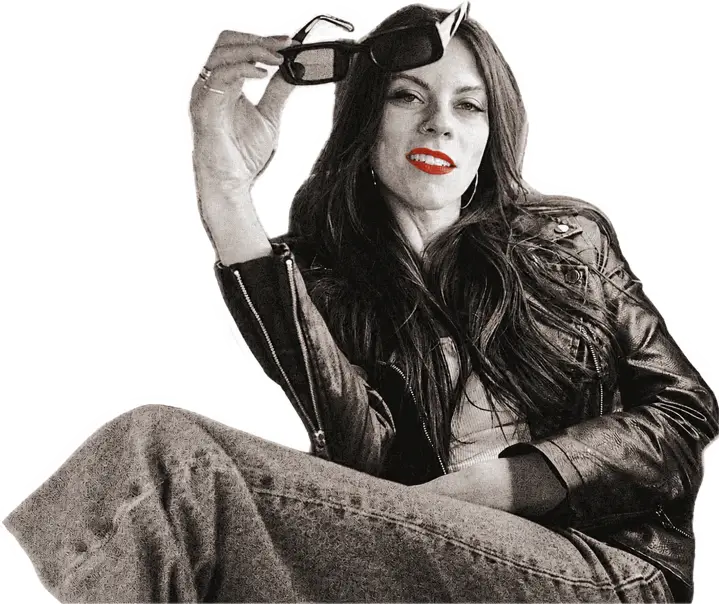

The first task the film industry ever handed Jennie Bovard was guarding a truck. It was an anti-drug PSA shooting in East Vancouver; she was the new production assistant, and the truck was full of expensive equipment.
The only issue—she’s legally blind.
“I didn’t say no. I can’t say no; it was like the first task,” she says. “But I’m standing there like, oh my god, anybody could walk up here and take stuff, and I wouldn’t know. I don’t see faces. I wouldn’t know if that was the guy that told me to stand here or if it was some Joe off the street.”
Nobody on set knew she was legally blind. Back then, in the late 2000s, she was fresh out of Toronto Film School with a diploma in film and television production. She hadn’t learned how to talk about her access needs or that she could ask for them, and nobody thought to ask her.
She figured she needed a plan B, and for years plan B meant admin and customer care jobs—occupations where her creative itch couldn’t quite be satisfied.
When she moved to Halifax (originally from New Brunswick), still chasing the itch, she walked into Accessible Media Inc. (AMI) wanting to volunteer—and they offered her a screen test instead.
She aced it.
With her wit and charisma, Jennie found her way back into the industry. She started by presenting and producing on AMI This Week, then moved on to community reporting in Nova Scotia and PEI, and later hosted live audio. Each job brought her closer to being on screen.
Now, Jennie shares her truck-guarding story and other funny moments, like mistaking walking-stick users for sword-wielding troublemakers, as jokes. The writers’ room for her hit scripted show, Pretty Blind, which airs on AMI, has heard all these stories and more.
“These funny little things happen all the time, and they make for interesting human interactions,” says Jennie, lead actor, associate producer and story editor for the hit show. “You can either laugh at them—in the moment or later on—or you can let them weigh you down forever and be frustrated and annoyed. I try to move on and do something with the stories.”
Jennie says most of what does happen on Pretty Blind has happened in real life, one way or another. All of its laugh-out-loud material led to the show winning Best Scripted Television Series at the Screen Nova Scotia Awards this spring.
The best part of Pretty Blind is that accessibility is built into the show from the ground up—ensuring everyone is in the laughs.
On screen, descriptions are included in the dialogue and sound, so blind and low-vision viewers can enjoy every joke. Casting blind and low-vision actors also makes a big difference.
“I’m 40 years old. Most people don’t start acting at 38, 39, 40 years old,” says Jennie. “And part of that is because I never saw myself represented in a positive way in film or television.”
For Jennie, representation on her terms skips the usual extremes of hero and tragedy:
“We’re not all Stevie Wonder or the guy that climbs mountains. Some of us just want to go to work, have a family, and be everyday people, and I think that’s a thing that’s lacking in blindness representation. There’s this thinking: you’re either a hero, or you sit at home sad, and you do nothing,” she says. “In the show, the folks that we’re featuring who are blind; we’re everyday people—which I think is important.”
Watch the trailer
The response tells her it’s working, especially from her own blind, low vision and albinism community. “I can’t think of another show that you can turn on today that does what Pretty Blind does,” she says. Viewers agree so thoroughly that some now approach her with their own stories, a few of which may well surface next season.
“I didn’t think that the film or television industry were for me, and I thought that because I encountered so many barriers and didn’t understand my own access needs as a person with a disability and albinism,” says Jennie. “What I’ve learned is that I can’t stay away from it.”
But an industry built on telling fresh stories needs variety, and fresh, true perspectives.
“We need to be accurately represented, so that we’re not reinforcing the stereotypes that are out there,” says Jennie. “I was not struck by lightning. I do not have any special powers. We need to get away from that and show the folks that we’re real, everyday people.”
Looking ahead, Jennie has many new and exciting projects as she steps into her next chapter.
The writers’ room for season two of Pretty Blind is already working, with plans for a 2027 release and even more stories and perspectives. Additionally, Jennie’s podcast, Low Vision Moments, which featured stories from other low-vision guests, ended after four years and 46 episodes; but soon, she’ll join a new AMI Audio podcast as one of several hosts, each with their own storytelling style. Jennie hopes to broaden the topics, moving beyond blindness and albinism to talk with friends and community members about other disability experiences, including some more serious subjects.
Listen
“There are going to be light moments, but I think I want to get into some more serious topics as well,” she says. “Diving into some things that are not really talked about, that I think we need to normalize and talk about in the disability community.”
Meanwhile, Jennie encourages anyone and everyone to check out season one of Pretty Blind (streaming free on AMIplus.ca) and to reach out to her to share their low-vision/blindness stories.
For someone whose first job was guarding a truck she couldn’t see, she’s looking ahead to brighter lights, cameras, and action in an industry in which she’s breaking ground.
“I really feel like I’ve made it,” says Jennie. “Like I’m Halifamous.”